Most of the time, re-boxing items and organizing shelves is deeply satisfying. But sometimes I am a little sad to say goodbye to ridiculousness of the old boxes. As annoying as it can be, you sort of have to laugh when you discover aging boxes helpfully labeled "miscellaneous feathers and fur bits" or "stuff from green table, moved 4/22/72."
This week I said goodbye to a personal favorite.
There is a section of accessories that is sort of a big mess, but which a few volunteers are helping to inventory. It includes a mix of archival boxes and boxes that were made long before anyone had an inkling that "archival" was a thing. On one of those shelves was this box:
Ok, sure, I thought to myself the first time I spotted it. Could be a muff with some pheasant feathers. Could also be something completely different and it is an old label. Let's find out...
WHOA...
THAT BOX DELIVERED ON ITS PROMISES. It is basically just AN ENTIRE PHEASANT that you can put your hands inside.
It is SICKENING, both in the traditional use of the word, and the drag queen use.
So now it has a better box and a label with its picture on the outside. Which is better for it, but there was something about the old box and the WHOA THE BOX DIDN'T LIE surprise that every time had me like:
subtitle
Life as the textile expert at a regional history museum
Saturday, March 19, 2016
Saturday, March 5, 2016
Quagmire Surprise
One of the tough things about collections work is that you can have a great plan for what you want to get done that day, and then just unexpectedly wander into a giant project that takes multiple days to resolve.
This week I was looking for interesting deaccessioned artifacts for a hands-on activity I'm doing at the museum. I wanted to show some examples of different kinds of damage (fading, bug holes, silk shattering) and I remembered seeing some boxes in storage labeled "examples of deterioration." I found them and brought them into the conservation lab to take a look. Sure enough, the boxes contained a bunch of super sad, damaged, crumbling-to-bits objects.
As I began looking at them I started to see accession numbers and I got nervous. These items were deaccessioned right? I mean everything is jammed together and there are like three dresses just wadded up in the bottom of this box. These aren't STILL ARTIFACTS ARE THEY?!?!?!
Oh yeah. They were artifacts.
I was reeeeeelly close to just closing the boxes back up, putting them back on the shelf, and pretending like I didn't see anything.
But no. I was in this mess and the only thing to do was to take the time to properly sort it out. I got out new, bigger boxes that would fit the items more comfortably. I re-packed everything and wrapped the boxes for freezing (since some of the "condition issues" were bug damage I wanted to be safe). Once they are out of the freezer I'll go through them more carefully, officially proposing some for deaccession and do my best to stabilize/clean/take care of anything we really should be keeping.
Once I went through everything, I actually discovered that the two items that were in the worst condition had already been deaccessioned.
...but one of them had a Seattle label.
This week I was looking for interesting deaccessioned artifacts for a hands-on activity I'm doing at the museum. I wanted to show some examples of different kinds of damage (fading, bug holes, silk shattering) and I remembered seeing some boxes in storage labeled "examples of deterioration." I found them and brought them into the conservation lab to take a look. Sure enough, the boxes contained a bunch of super sad, damaged, crumbling-to-bits objects.
As I began looking at them I started to see accession numbers and I got nervous. These items were deaccessioned right? I mean everything is jammed together and there are like three dresses just wadded up in the bottom of this box. These aren't STILL ARTIFACTS ARE THEY?!?!?!
Oh yeah. They were artifacts.
I was reeeeeelly close to just closing the boxes back up, putting them back on the shelf, and pretending like I didn't see anything.
But no. I was in this mess and the only thing to do was to take the time to properly sort it out. I got out new, bigger boxes that would fit the items more comfortably. I re-packed everything and wrapped the boxes for freezing (since some of the "condition issues" were bug damage I wanted to be safe). Once they are out of the freezer I'll go through them more carefully, officially proposing some for deaccession and do my best to stabilize/clean/take care of anything we really should be keeping.
Once I went through everything, I actually discovered that the two items that were in the worst condition had already been deaccessioned.
...but one of them had a Seattle label.
Monday, February 8, 2016
Designer Label Freakout
As a Seattle-based fashion historian I try not to be too elitist and couture-focused when discussing clothing. Fashion is not just for the rich! Practical clothing can be stylish! Plaid shirts are sexy!
But today I'm going to tell you the story about how I nearly had an excitement-induced heart attack when discovering a famous Paris designer label on something in the museum collection.
A volunteer and I were preparing a dress for display and something was funny about how the hemline was hanging. So I decided to steam it a little bit. It was a 1920s evening dress with sequins, and I knew that sometimes sequins from that period can be made of gelatin and can literally melt. So I decided to turn the dress inside-out and be extremely cautious. As soon as I had it inside-out I spotted it:
(It took a while)
...I spent a little time researching the donor. Her name was Edana Collins Ruhm, and this is what she looked like on her wedding day in 1906:
Her father was the fourth mayor of Seattle, and she grew up in luxury in the Collins mansion. Her husband died young, and so she spent the next 50 years of her life as a widow. She travelled, she gave lectures, and generally appeared to live it up. The travel included frequent trips to Paris, and she was described in the Seattle society news as wearing Patou, so it isn't some weird coincidence that she donated this dress. This was her dress.
Ok, ok, enough background. Here it is:
But today I'm going to tell you the story about how I nearly had an excitement-induced heart attack when discovering a famous Paris designer label on something in the museum collection.
A volunteer and I were preparing a dress for display and something was funny about how the hemline was hanging. So I decided to steam it a little bit. It was a 1920s evening dress with sequins, and I knew that sometimes sequins from that period can be made of gelatin and can literally melt. So I decided to turn the dress inside-out and be extremely cautious. As soon as I had it inside-out I spotted it:
I was basically like:
Jean Patou was an innovative couture designer in the 1920s and early 1930s (he died in 1936). In his time he was on par with Chanel in influence and success. If you google image search him you will also discover that he was dapper AF:
![]() |
| Library of Congress, George Grantham Bain Collection, PD-US |
![]() |
| via perfumesociety.org |
After calming down a little...
...I spent a little time researching the donor. Her name was Edana Collins Ruhm, and this is what she looked like on her wedding day in 1906:
![]() |
| MOHAI collection |
Ok, ok, enough background. Here it is:
BAM
This is some HIGH LEVEL HARDCORE MUSEUM QUALITY FASHION
Also, look again at the wedding photo and then look at this dress (c. 1925-26). What better illustration of the seismic shift in women's fashion between the turn of the 20th century and the 1920s? She was in her twenties on her wedding day-- all frothy and demure in ruffles -- and in her forties when she purchased the dress above.
DAMN GIRL.
GET IT.
also can we just recap the fact that THIS DRESS IS IN THE COLLECTION I MANAGE AND HAS A LEGIT MISSION-RELATED STORY
(It is on display now if you want to see it in person)
Sunday, January 24, 2016
How Studying Fashion Made Me Feel Better About My Body
Like 99.99% of adult women in this country, I sometimes feel bad about my body. So fun! Being a woman is the best.
Anyway, the other day I looked down at my stomach and saw that I was developing bit of a belly. And I felt gross, because everyone knows that women are supposed to have flat stomachs. But then I remembered some things I've learned in fashion history, and I shut down that body-shaming nonsense.
Some might think that studying fashion would make me feel worse about my body. There are all kinds of studies that show that a woman's self esteem goes down after paging through a magazine full of idealized, photoshopped images. I don't doubt that. The fashion of any particular time always revolves around an ideal body, and we are always fooled into thinking that the ideal body of this time in history and place in the world is permanent and universal. If what you see in the mirror doesn't match what you see in the pictures, something is wrong with you. But once you back up and look at images of beauty across time and geography, you realize how meaningless today's ideal actually is.
Let's start with the idea of "belly fat"
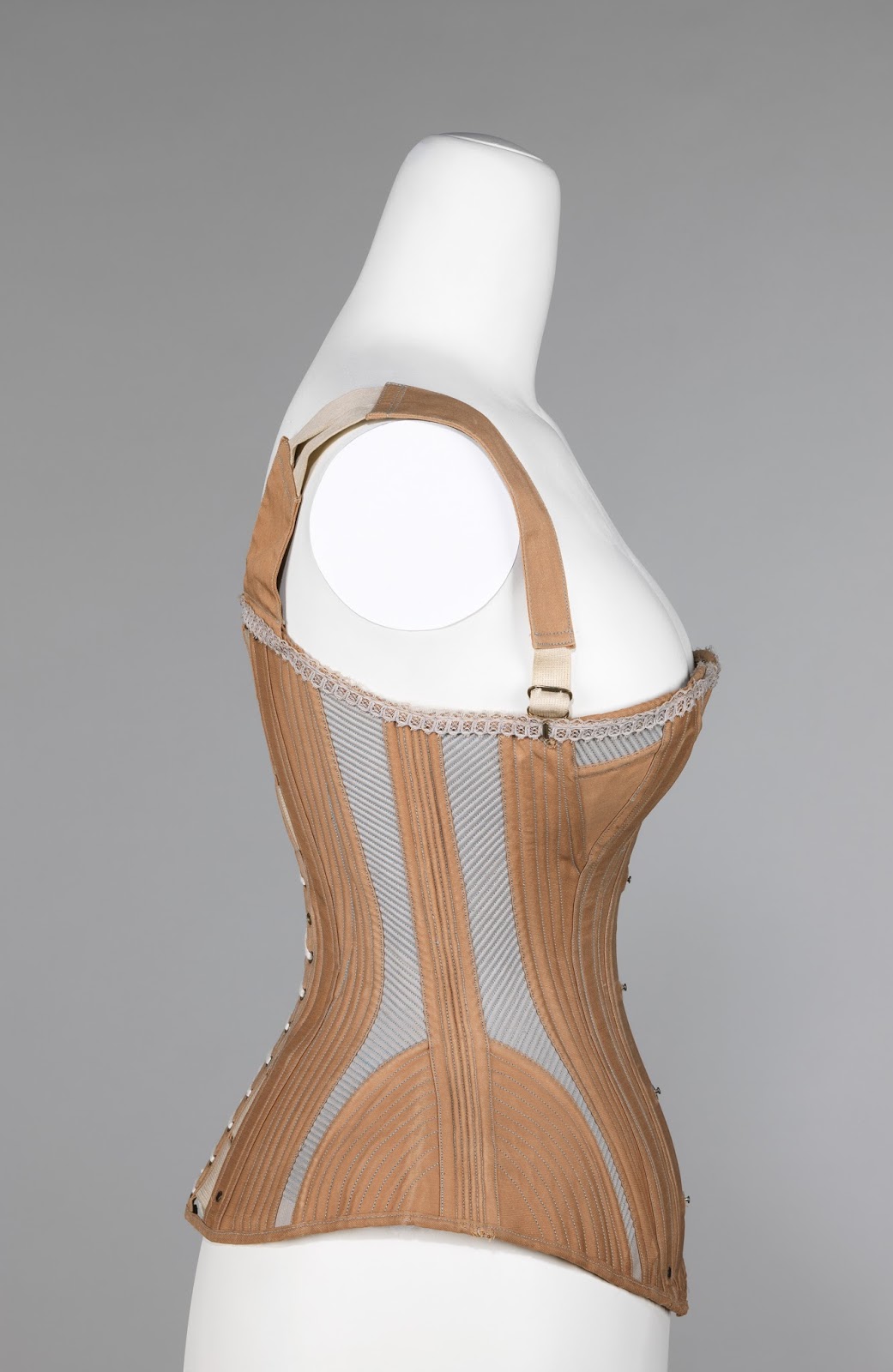
It seems like every time I dress a late 1880s dress on a mannequin, I or one of my volunteers makes the same rookie mistake. The late 1880s was a period of bustles and hourglass corsets, and when padding the body, my volunteers and I envision the hourglass as having only three sides: small waist with fullness at the back and hips. Our 21st century instincts make sure the front is flat, like we think it "should" be. But the dresses always look weird and saggy when we do it that way. Why? Because Victorians didn't give a s#*t about having a flat stomach.
When you cinch the waist the flesh has to go somewhere, and so corsets and dresses were built to bulge back out below the waist. Once we remember this, we stuff some "belly fat" onto the form and the front of the dress suddenly drapes beautifully. Victorians may have had all kinds of restrictive beauty ideals about paleness, sloping shoulders, and tiny waists, but when it came to stomachs they were basically like DUH WOMEN HAVE BELLIES IT IS A BIOLOGICALLY NORMAL PLACE TO HAVE FAT.
But it wasn't just that women's bellies were tolerated or ignored in the past, there were also times when they were openly celebrated. Remember this painting from art history class?
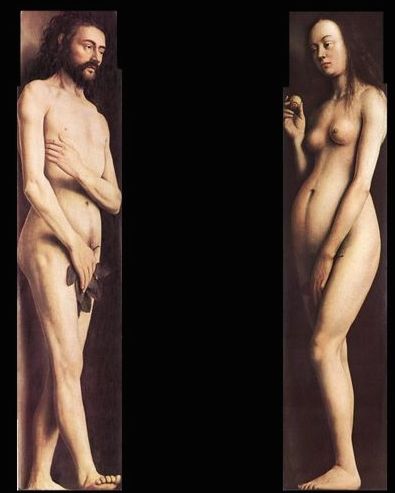
At first glance, many assume that the woman is pregnant. I mean, she has some serious belly fullness going on. But if you look more closely, you see that she is actually lifting up the front folds of her dress and creating the illusion of fullness. Why? Because that was considered a fashionable, elegant gesture at the time. The ideal in this part of the world and at this time included a full, swollen belly for women--not as a symbol of pregnancy, just for everyday fabulousness. Don't believe me? Here is a painting by the same artist of Adam and Eve:
Today we are also convinced that a "good" body should be toned and taut, but in the early 17th century the beauty ideal called for fleshy softness and skin full of rippling dimples.
Some might think that studying fashion would make me feel worse about my body. There are all kinds of studies that show that a woman's self esteem goes down after paging through a magazine full of idealized, photoshopped images. I don't doubt that. The fashion of any particular time always revolves around an ideal body, and we are always fooled into thinking that the ideal body of this time in history and place in the world is permanent and universal. If what you see in the mirror doesn't match what you see in the pictures, something is wrong with you. But once you back up and look at images of beauty across time and geography, you realize how meaningless today's ideal actually is.
Let's start with the idea of "belly fat"
It seems like every time I dress a late 1880s dress on a mannequin, I or one of my volunteers makes the same rookie mistake. The late 1880s was a period of bustles and hourglass corsets, and when padding the body, my volunteers and I envision the hourglass as having only three sides: small waist with fullness at the back and hips. Our 21st century instincts make sure the front is flat, like we think it "should" be. But the dresses always look weird and saggy when we do it that way. Why? Because Victorians didn't give a s#*t about having a flat stomach.
![]() |
| Madame McCabe corset, 1887-90. Metropolitan Museum of Art. |
When you cinch the waist the flesh has to go somewhere, and so corsets and dresses were built to bulge back out below the waist. Once we remember this, we stuff some "belly fat" onto the form and the front of the dress suddenly drapes beautifully. Victorians may have had all kinds of restrictive beauty ideals about paleness, sloping shoulders, and tiny waists, but when it came to stomachs they were basically like DUH WOMEN HAVE BELLIES IT IS A BIOLOGICALLY NORMAL PLACE TO HAVE FAT.
But it wasn't just that women's bellies were tolerated or ignored in the past, there were also times when they were openly celebrated. Remember this painting from art history class?
![]() |
| Jan van Eyck The Arnolfini Portrait, 1434 |
At first glance, many assume that the woman is pregnant. I mean, she has some serious belly fullness going on. But if you look more closely, you see that she is actually lifting up the front folds of her dress and creating the illusion of fullness. Why? Because that was considered a fashionable, elegant gesture at the time. The ideal in this part of the world and at this time included a full, swollen belly for women--not as a symbol of pregnancy, just for everyday fabulousness. Don't believe me? Here is a painting by the same artist of Adam and Eve:
Or this one from another artist:
![]() |
| Pol de Limbourg The Earthly Paradise from Très Riches Heures du Duc de Berry |
![]() |
| Peter Paul Rubens The Three Graces, 1635 |
Anne Hollander covers a lot of this in her book Seeing Through Clothes. She discusses nudes and nakedness in western art and how you can always tell what the clothes of the period are like because the bodies are shaped the way the clothes are shaped. She says stuff like...
![]() |
| Barnardino Luini Venus, 1530 |
In general the female body of the High Renaissance appears to have been conceived as a long, large stomach stretching from the collarbone to the crotch, with breasts the shadowiest of swellings. (Hollander, pg. 104)
So basically today someone might feel bad about her small breasts and "thick" waist, but in another era artists would fawn over her perfect proportions. The point is not that these past eras were utopias of body acceptance, but that the ideal is constantly shifting. Fashion tricks us into having here-and-now tunnel vision, but fashion history gives us a way to step out of our own time and see the bigger picture.
And the bigger picture is this: If you identify as a human woman, you have a woman's body. There is no "real" woman's body, there is no attribute that all women "should" have, there is no universal standard of beauty. Even if our culture in this time and place tries to tell you that nothing about you is beautiful, you are entitled to feel beautiful anyway. And if feeling beautiful isn't important to you, you are also entitled to not give a crap.
Saturday, January 2, 2016
End of Year Cleanup
One of the best gifts I got for Christmas this year was a vase of fake flowers for my desk. You see, I'm not allowed to have fresh flowers in my office. (Actually, I always feel sort of strange saying that I'm "not allowed" as if it is cruelly banned by some order on high. Us collections folks put that rule on ourselves. We are obsessed with keeping bugs out of the collection, and so we self-impose a no food and no fresh flowers policy in our office space.) So my parents bought me a lovely vase of fake flowers.
One requirement of the gift was that I clean off my work desk to make room for them. I have a problem of allowing mountains of papers to pile up on my desk, and since last year I was sick on New Year's Eve for my usual year-end desk clean-off day, I had TWO YEARS worth of desk piles to go through this year.
But I got through it and oh man did it feel good. I love the last two weeks of the year. It is a quiet time to just wrap up a lot of loose ends and get stuff done. Besides cleaning off my desk I...
Put away about 40 hats that had been inventoried but not yet put in boxes
Finished processing all the 2015 clothing and textile accessions
Best moment for that was when I was going through some items from the 1990 Goodwill games and was using my friend EB (who was a Russian major) to help translate the text on a shirt that had been purchased from a vendor at the games. Here is paraphrased version of our text conversation:
Me: Can I get some help with some Russian translation?
EB: Yes!
Me: [Sends photo of patches on shoulders]
Me: It is a sailor-style shirt that looks very official. So maybe the word is "Navy" or "Security"?
EB: Umm....I think it says "Fish Farm"
(We eventually figured out that it was an abbreviation for the Ministry of Fisheries)
Finished a super exciting data cleanup project that a volunteer and I have been chipping away at for over a year
Wrapped up some loose ends from the shoe project
There were some random socks and spats that had been found on the shelves which needed to be moved to different places, and there were two pairs of thigh-high boots which I hadn't figured out what to do with yet.
The shafts of the boots (yes, that is what it is called) were very fabric-y so rather than stuff them like tall leather boots, I stuffed the feet and then rolled the tops of the boots into neat little bundles.
Found some interesting stuff on my messy desk
On a page of random notes from something I attended in 2015 I found the following message:
"A necessary first step to grandeur is a delusion of grandeur"
I've decided to make that my motto for 2016.
One requirement of the gift was that I clean off my work desk to make room for them. I have a problem of allowing mountains of papers to pile up on my desk, and since last year I was sick on New Year's Eve for my usual year-end desk clean-off day, I had TWO YEARS worth of desk piles to go through this year.
But I got through it and oh man did it feel good. I love the last two weeks of the year. It is a quiet time to just wrap up a lot of loose ends and get stuff done. Besides cleaning off my desk I...
Put away about 40 hats that had been inventoried but not yet put in boxes
Finished processing all the 2015 clothing and textile accessions
Best moment for that was when I was going through some items from the 1990 Goodwill games and was using my friend EB (who was a Russian major) to help translate the text on a shirt that had been purchased from a vendor at the games. Here is paraphrased version of our text conversation:
Me: Can I get some help with some Russian translation?
EB: Yes!
Me: [Sends photo of patches on shoulders]
Me: It is a sailor-style shirt that looks very official. So maybe the word is "Navy" or "Security"?
EB: Umm....I think it says "Fish Farm"
(We eventually figured out that it was an abbreviation for the Ministry of Fisheries)
Finished a super exciting data cleanup project that a volunteer and I have been chipping away at for over a year
Wrapped up some loose ends from the shoe project
There were some random socks and spats that had been found on the shelves which needed to be moved to different places, and there were two pairs of thigh-high boots which I hadn't figured out what to do with yet.
The shafts of the boots (yes, that is what it is called) were very fabric-y so rather than stuff them like tall leather boots, I stuffed the feet and then rolled the tops of the boots into neat little bundles.
Found some interesting stuff on my messy desk
On a page of random notes from something I attended in 2015 I found the following message:
"A necessary first step to grandeur is a delusion of grandeur"
I've decided to make that my motto for 2016.
Sunday, December 20, 2015
In All The Choirs: Christmas Update
As I mentioned back in October, my time has been consumed with approximately 75% more choir than last year. I thought I would get burnt out, but it hasn't happened yet. And now that it is December I am LOVING all the Advent and Christmas music I get to sing.
Side note: I also like it when the sheet music has weird illustrations on the cover. Like, what exactly is going on here?
Anyway, last weekend I went to a Christmas crafting party that I go to just about every year. It is with a friend's family, and while everyone else has cool creative stuff to work on I usually just grab all the old magazines I can find and glue together some weird collage. I've never quite lived down my masterpiece from the first year I went, when we all made "pin-a-peeps" which are basically dioramas set up in a shoebox that you view from a hole at one end of the box. This was mine:
If you can't quite tell, that is Christina Aguilera and her underboob peeking out from behind a festively snowy tree.
I've yet to make anything quite that good, but I've been decently proud of some of my other creations. Here is one from a couple years ago:
I woke up on the morning of the craft party this year with no good ideas. But after a morning of singing I felt inspired by our purple and white choir robes. So I ended up making myself a little celebrity choir.
Side note: I also like it when the sheet music has weird illustrations on the cover. Like, what exactly is going on here?
If you can't quite tell, that is Christina Aguilera and her underboob peeking out from behind a festively snowy tree.
I've yet to make anything quite that good, but I've been decently proud of some of my other creations. Here is one from a couple years ago:
I woke up on the morning of the craft party this year with no good ideas. But after a morning of singing I felt inspired by our purple and white choir robes. So I ended up making myself a little celebrity choir.
(I suggest clicking on it to get the full view)
Not gonna lie, I think it is a minor masterpiece.
This week I'm looking forward to experiencing a Christmas Eve singing marathon-- one of my choirs is singing for the 7:30 service and the other for the 11pm. ELEVEN PM IS THE START TIME. I'm hoping i'll be so hopped up on Christmas cheer and Wilcox descants that I won't even notice how tired I am. But if I start hallucinating and Jane Fonda appears to me in the Soprano section...well... it might be a weird Christmas.
Sunday, December 6, 2015
Fashion in Unexpected Places
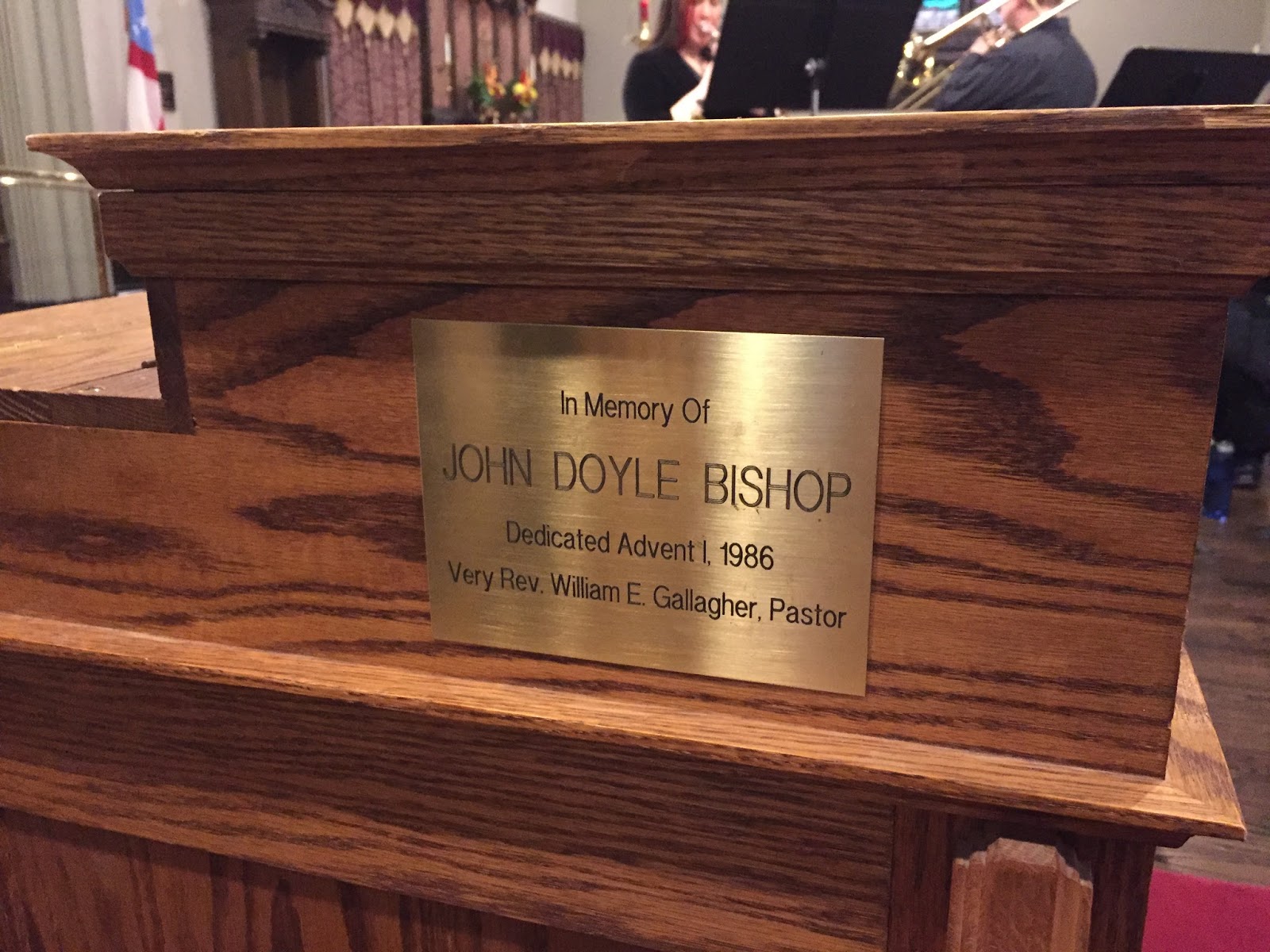
A few weeks ago I was at a concert at an old church in Seattle. They had rented a small organ from St. James (Catholic cathedral up the hill) for some pieces that needed more of a small continuo sound rather than the big pipe organ. At the intermission my Dad, ever the organ nerd, went up to check it out. He came back excitedly saying that I had to see something. I expected that I was going to have to muster up some enthusiasm for the keyboard or the style of pipes, but instead this is what he was pointing to:
In case you can't read it, the little plaque says:
John follows me everywhere!!
Since JDB passed away in 1980, this would probably have been purchased with money he left to St. James after his death. (As opposed to the green carpet he bought for the church while he was still around to enjoy it.) I always find it meaningful to discover some new, tangible mark left by someone from the past. John left money for St. James to use for the arts, and 30 years later it is still being used and enjoyed by the people of Seattle.
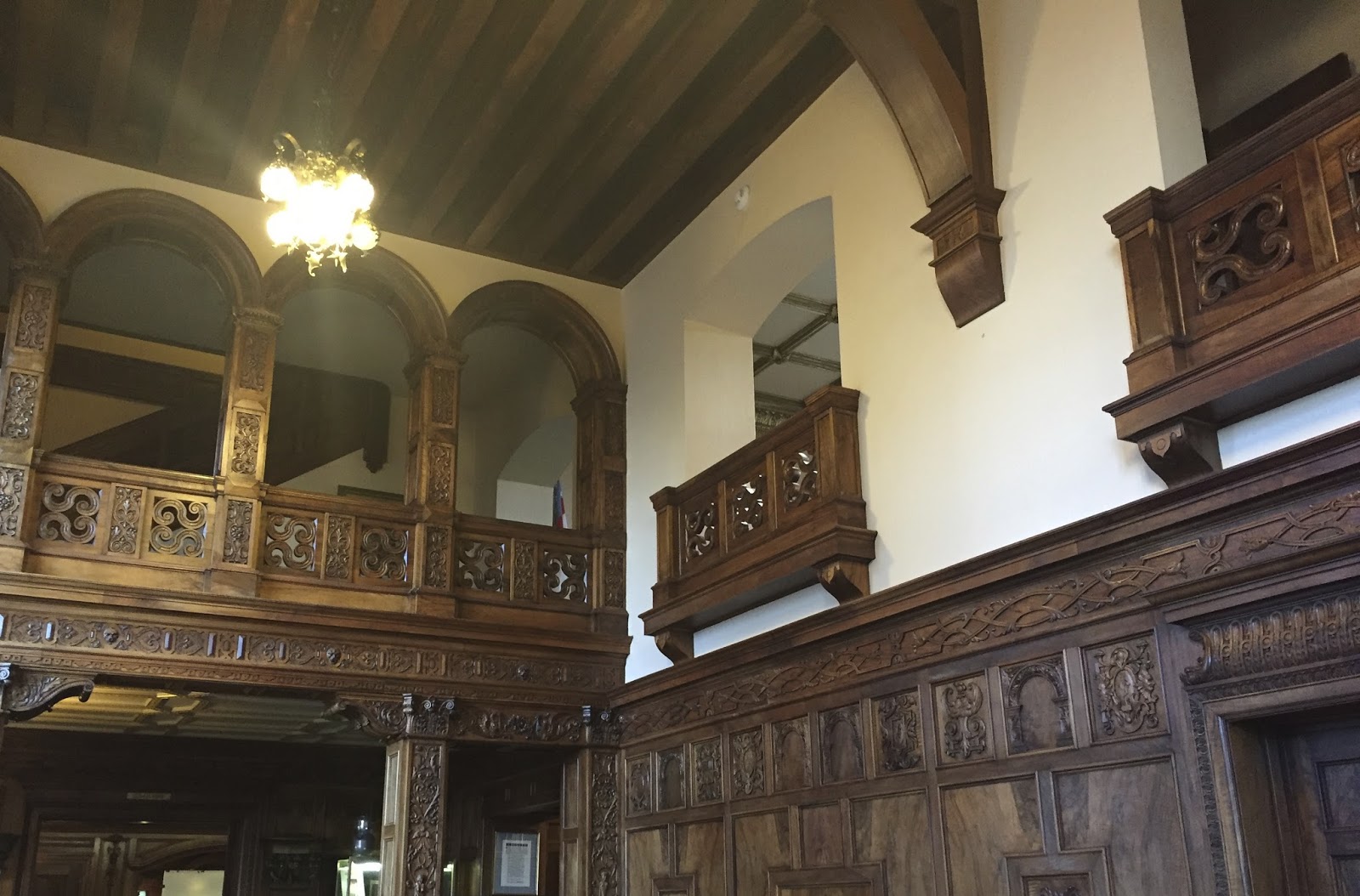
Speaking of lasting marks left by people of the past, I had the joy this week of visiting the Leary Mansion again, aka the HQ for the Episcopal Diocese of Olympia. It was with a group of other registrars and collections managers and we got a full tour.
No one seemed to be in that day so the archivist took us everywhere, even the Bishop's office.
In case you can't read it, the little plaque says:
In Memory Of
JOHN DOYLE BISHOP
Dedicated Advent I 1986
John follows me everywhere!!
Hay Girl Hay
Since JDB passed away in 1980, this would probably have been purchased with money he left to St. James after his death. (As opposed to the green carpet he bought for the church while he was still around to enjoy it.) I always find it meaningful to discover some new, tangible mark left by someone from the past. John left money for St. James to use for the arts, and 30 years later it is still being used and enjoyed by the people of Seattle.
Speaking of lasting marks left by people of the past, I had the joy this week of visiting the Leary Mansion again, aka the HQ for the Episcopal Diocese of Olympia. It was with a group of other registrars and collections managers and we got a full tour.
No one seemed to be in that day so the archivist took us everywhere, even the Bishop's office.
I'M IN UR OFFICE CHECKING OUT UR CROZIER
But the best part was the fireplace in the bedroom of the original owner, Mrs. Leary.
What have we here?
I thought it was sort of funny that in this pseudo-classical scene of nymphs and cherubs, this lady was wearing a 1920s bathing suit. But then the archivist explained that she was originally painted naked and that at some point someone decided she needed to be covered up. And apparently it wasn't the church people who did it! It happened before the church bought the building, so either Mrs. Leary didn't like people leering at it, or it was the Red Cross workers who used the house during WWII.
Also, this time I snapped a picture of one of those Ted Rand bishop paintings:
Ted Rand who also created images like this:
So there it is. John Doyle Bishop sneaking into 21st century choir concerts, vintage bathings suits making appearances in pastoral fire places, and fashion illustration entwined with church portraiture. Wherever you are, fashion will find you.
Subscribe to:
Posts (Atom)