subtitle

Life as the textile expert at a regional history museum
Showing posts with label Frederick & Nelson. Show all posts

Sunday, December 6, 2015

Fashion in Unexpected Places

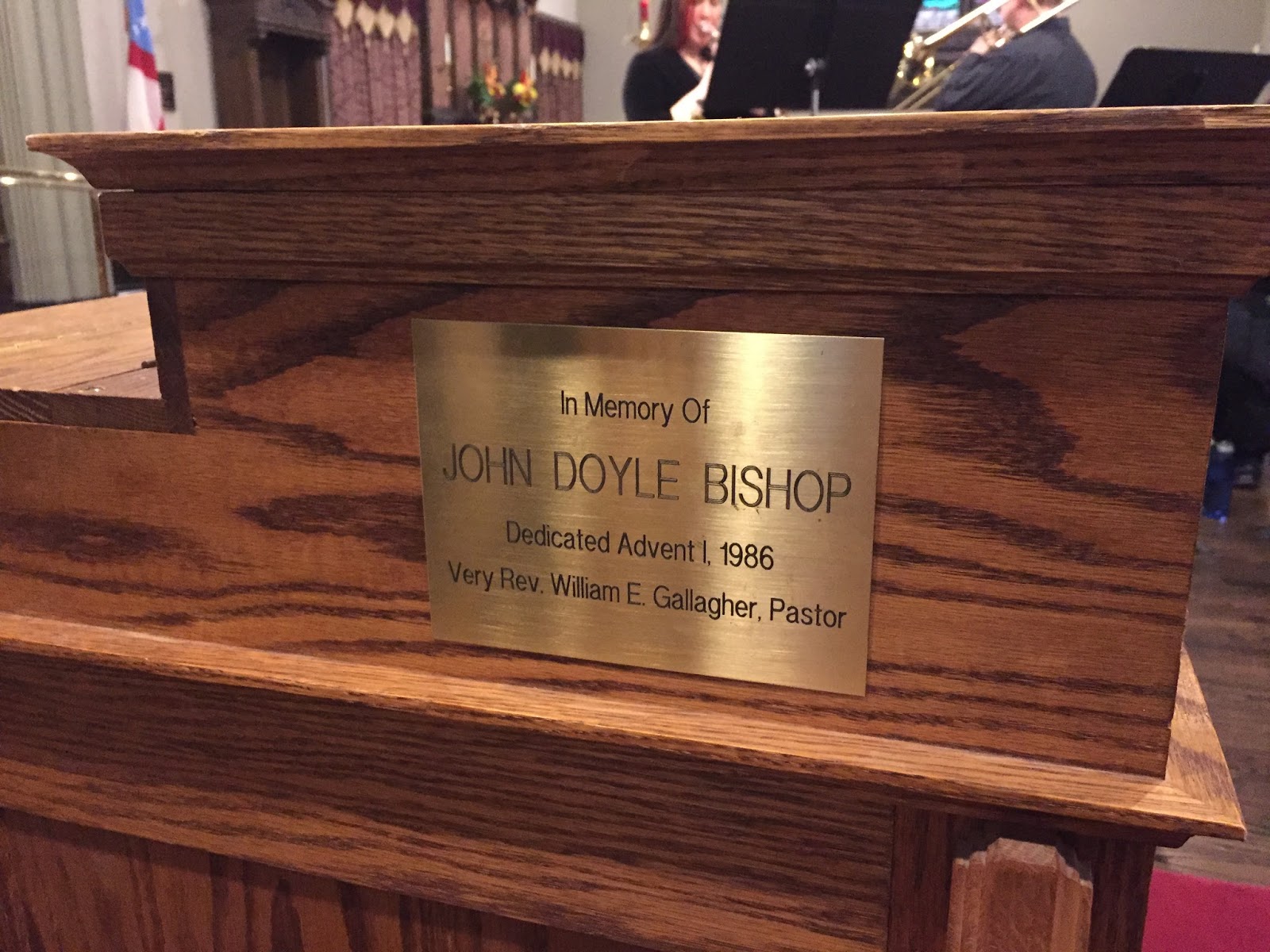
A few weeks ago I was at a concert at an old church in Seattle. They had rented a small organ from St. James (Catholic cathedral up the hill) for some pieces that needed more of a small continuo sound rather than the big pipe organ. At the intermission my Dad, ever the organ nerd, went up to check it out. He came back excitedly saying that I had to see something. I expected that I was going to have to muster up some enthusiasm for the keyboard or the style of pipes, but instead this is what he was pointing to:


In case you can't read it, the little plaque says:

In Memory Of
JOHN DOYLE BISHOP
Dedicated Advent I 1986

John follows me everywhere!!

Hay Girl Hay

Since JDB passed away in 1980, this would probably have been purchased with money he left to St. James after his death. (As opposed to the green carpet he bought for the church while he was still around to enjoy it.) I always find it meaningful to discover some new, tangible mark left by someone from the past.  John left money for St. James to use for the arts, and 30 years later it is still being used and enjoyed by the people of Seattle.

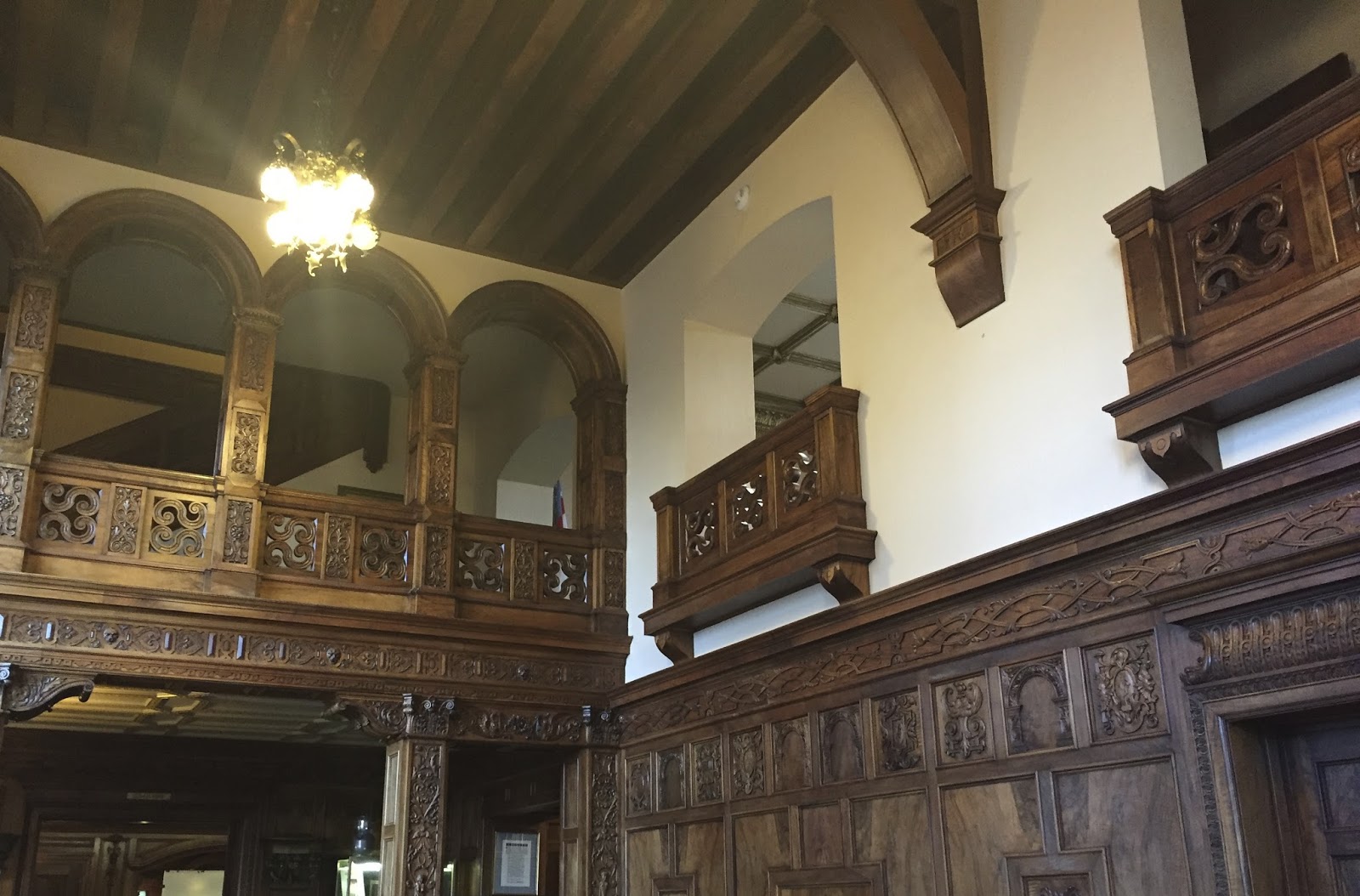
Speaking of lasting marks left by people of the past, I had the joy this week of visiting the Leary Mansion again, aka the HQ for the Episcopal Diocese of Olympia. It was with a group of other registrars and collections managers and we got a full tour.


No one seemed to be in that day so the archivist took us everywhere, even the Bishop's office.

I'M IN UR OFFICE CHECKING OUT UR CROZIER

But the best part was the fireplace in the bedroom of the original owner, Mrs. Leary. 


What have we here?


I thought it was sort of funny that in this pseudo-classical scene of nymphs and cherubs, this lady was wearing a 1920s bathing suit. But then the archivist explained that she was originally painted naked and that at some point someone decided she needed to be covered up. And apparently it wasn't the church people who did it! It happened before the church bought the building, so either Mrs. Leary didn't like people leering at it, or it was the Red Cross workers who used the house during WWII.

Also, this time I snapped a picture of one of those Ted Rand bishop paintings:


Ted Rand who also created images like this: 


So there it is. John Doyle Bishop sneaking into 21st century choir concerts, vintage bathings suits making appearances in pastoral fire places, and fashion illustration entwined with church portraiture. Wherever you are, fashion will find you. 

Monday, September 15, 2014

Deaccessioning: Everyone Remain Calm

This past month I've been spending a lot of time on one of the most complicated, stressful and controversial things that collections departments do: Deaccessioning.

Now, if you type "deaccession" or "deaccessioning" into Word you will get an immediate red squiggle because no one outside the museum world knows what it is. Basically, to "accession" something into a museum is to make it part of the collection. So to "deaccession" is to remove it from the collection. 

It is controversial and misunderstood because the public tends to FREAK OUT when they hear a museum is getting rid of something. The immediate assumption is either 1) We are tossing priceless cultural artifacts into the dumpster or 2) We are selling off the collection so that the whole staff can get yachts.


Our actual intentions are much less nefarious. To begin with, people don't realize how large museum collections are. Most museums have only about 5-10% of their collection on display at any given time. With 100,000 artifacts and about 2,000 on display, MOHAI clocks in at 2%. So you shouldn't picture beloved artifacts disappearing from display--it is usually stuff you never knew about is departing from deep corners of storage. 

MOHAI has one hundred thousand artifacts. Let that sink in a little. Are you picturing the final scene from Raiders of the Lost Ark? That is what it feels like sometimes. We have thousands of square feet of storage space and some of it is packed full. In order to be good stewards of the collection (and have space to keep collecting new things) we have make sure we are using our resources to care for things that are actually relevant to our mission. 

So, say for example that we decide to deaccession a typewriter. "NO!" the public cries, "Typewriters were an essential writing tool before personal computers. How will our children know about typewriters if the museum doesn't teach them?" 

Usually said with some combination of hand wringing and/or pearl clutching

What if then I tell you we have 84 typewriters in the collection. The one we are deaccessioning is one of thirty that have no connection to Seattle, one of twenty that are broken, and one of six from the exact same year. Once it is deaccessioned there will still be 83 typewriters in the collection. 

Starting to get it? 

But the real panic sets in about what we do with things we deaccession. Does it all go in the dumpster? Does it end up in the curator's home? Do we sell it in some back alley transaction, get the money in singles, and then ask an intern to "make it rain"?

Sounds ethical to me!

Ok, I keep making fun of the "the public" but they do have a point about all this. Museums shouldn't have free rein to get rid of things that we have been entrusted to care for. Which is why there are a lot of ethical rules that govern deaccessioning. Like, a lot. I started writing a list but it turned this already long post into a short novel.

Here is the abbreviated, abbreviated version:
-The process is long, involves doing research, and a committee that has to vote unanimously on the decision.
-Once deaccessioned, it is preferable to transfer items to other institutions while sale is a second choice. Not all museums make that priority but MOHAI does and we are lucky that the board members on our collections committee really uphold it (sometimes it is board members who can get dollar signs in their eyes and want to sell, sell, sell).
-If things are sold, no one associated with the museum can buy them (huge conflict of interest) and the money earned can only go back into improving the care of the collection (so artifacts can't be sold off to solve a museum's finical woes and/or facilitate yacht buying).

Hopefully at this point you aren't lighting your torches and heading off to rescue all the artifacts since clearly we can't be trusted with this "deaccessioning" business.

Anyway, I've been having a lot of fun working on deaccession proposals. As part of the process we research the artifact, the donor, the maker, and any other shred of information in case we uncover some reason why the object is worth keeping. Sometimes when I go down a rabbit hole of society intrigue in early 20th century Louisiana or family trees in Minnesota I'll feel like I'm going overboard, but deaccessioning really should be about doing our due diligence.

Because of these stockings I learned that "Bowbells" is the 106th largest town in North Dakota

The research also helps with transferring items. The more you know, the easier it is to find another institution that might be a better fit. When stuff clearly has no Puget Sound connection, it is fun to poke around on the internet, find some potentially relevant museum or historical society, and then send an email and make a connection with a colleague in some other corner of the country.

But sometimes stuff stays close to home. Last month we deaccessioned a surplice (which is your liturgical vocabulary word of the day!) that had belonged to Bishop Stephen Bayne, third Bishop of the Diocese of Olympia.

also known as a church caftan

Despite its name, the Diocese of Olympia is headquartered in Seattle, and Bishop Bayne is one of the predecessors of my oil-dumping friend Greg. BUT this particular surplice was made by for his ordination in New York (made by his mother! awwww) and so doesn't really tell the story of his ministry in Washington.

Bishop Bayne donated it to MOHAI about twenty years before the Diocese of Olympia set up their own archive. So we deaccessioned it and transferred it there, so it could hang out with other vestments and the personal papers of Bishop Bayne.  I got to take it personally to archive, which is held in the top floor of the beautiful Diocesan House on Capitol Hill. The archivist showed me around and told me about the house, the portraits of all the Bishops, and the contents of the archives. She kept apologizing for "probably telling you more than you wanted to know" and I was like ARE YOU KIDDING I'M EATING THIS UP!!!

Kids in Candy Stores = Museum People in Old Mansions
The most exciting thing was that two of the Bishop portraits were painted by Ted Rand, a Seattle-area painter and illustrator who also did ads for Frederick & Nelson in the 1950s.

Ted Rand: Illustrator of Fashion, Painter of Bishops
See, deaccessioning isn't scary and evil! It finds happy homes for neglected artifacts, creates connections between organizations, and somehow led us into a world were you can talk about local church history and fashion advertising in the same sentence. EVERYONE WINS.

Saturday, July 12, 2014

The Fashion Historian's Guide to Seattle

I've been meaning to do this one for a while, and was re-inspired this week when a grad school classmate of mine was in town. If you are a fashion historian (either visiting or local) what are best spots to visit in Seattle?

Obviously I could do a miles-long list of "on this site was ____" or "the offices for this company are at____" but I limited it to things that are open to the public and actually have something that you can go in and see.

So put on your walking shoes and suit up in your best outfit, we are going on a Seattle Fashion History Tour!


The Museum of History and Industry - 860 Terry Ave N 

Duh. Of course you have to visit my museum. If you don't know already, MOHAI tells the story of Seattle and the Puget Sound region. There are about ten dressed mannequins on display in the core exhibit True Northwest: The Seattle Journey, as well as lots of interesting smaller things in cases. The actual selections get rotated every six months, but the core themes remain the same. Some highlights include:

- An 1850s-60s dress representing something that could have been worn by an early pioneer
- A late 1880s bustle dress in the faux shop window for local department store Toklas & Singerman.
- A 1920s couple (guy in a tux, lady in an evening dress) in the section about Prohibition
- A 1950s outfit in the section about postwar changes, usually something known to have been purchased from a Seattle business
- A face-off of World's Fair outfits- something suitable for the 1909 Alaska Yukon Pacific Exposition across from a modernist "Century 21" look from the future-focused 1962 fair.

The photo above is of a Luly Yang couture gown with the Rainier R neon sign reflected in the case. The dress is on display until early August, but don't worry-- I have have something else jaw-dropping to go in its spot.


Nordstrom / Frederick & Nelson - 500 Pine Street
Nordstrom History on Historylink
Frederick & Nelson History on Historylink 
Frederick & Nelson c. 1918. MOHAI Photo Collection

Nordstrom is a fabulous and fashionable Seattle institution. With cash in his pocket from the Klondike Gold Rush, John Nordstrom set up a shoe store in 1901. In 1963 the Nordstrom family bought Best's Apparel and started selling clothes too. By 1985 it was the largest specialty store chain in the country, surpassing previous title-holder Saks Fifth Avenue. The flagship store in downtown Seattle is lovely and inviting. And make sure to visit the fourth floor (just before you cross over the skybridge to Pacific Place) there are usually a few historic shoes on display from the archives.


The building itself is historic, and Nordstrom is a relatively new tenant. When I grew up, Nordstrom was in a hodgepodge of connected buildings on the opposite corner.  This grand retail temple used to be home to Frederick & Nelson, a beloved department store founded in 1891. I like to say that the building at 500 Pine has been responsible for changing and revitalizing the downtown retail core three times. When Donald Frederick decided to build the building, people called it "Frederick's Folly" because it was so far uptown from 2nd Ave, which was the hub of the retail core at the time. But when it opened in 1918 it was a big success, and other retailers soon moved to be nearby. In the early 50s the building underwent a major renovation which included adding several floors. This set off a chain reaction of other renovations and expansions of the downtown stores. Frederick & Nelson went bankrupt in 1992 and Nordstrom moved in in 1998, sparking revitalization in the area once again.


The Bon Marché - 1601 3rd Avenue 
The Bon Marché on Historylink
Photo from Patricksmercy on flickr 

This building is now a Macy's, but every good Seattleite slips up now and then and calls it "The Bon." Founded in 1890 by Josephine and Edward Nordhoff, and named for the famous French department store, The Bon Marché was a major retail player in Seattle for over 100 years. This gigantic art-deco flagship store was built in 1928. There are still a few touches that will take you back in time: the elegant woodwork around the elevators on the first floor, the faded elegance of the ladies restroom on the second floor, and the bronze artwork "The Spirit of Northwest Industry" which is on either side of the escalators between the basement and the first floor. The piece was made in 2000, but the top eight panels (Fisheries, World Trade, Aviation, Mining, Forestry, Manufacturing, Agriculture, Construction) are reconstructions of bronze panels made in 1929. The artist then added two new panels: Retail and Technology. The "Retail" panel, of course, shows The Bon Marché and has a profile of Josephine Nordhoff. 


If you read the article on Historylink, you'll find out why Josephine gets top billing over her husband Edward. #InspiringLadies


Ruth Hill - 411 University St
Located inside the Fairmont Olympic Hotel

Photo courtesy of Ruth Hill

In 1910 a woman named Helen Igoe opened a speciality fashion shop unlike anything else in Seattle. Her taste was exquisite and she carried clothing from the top houses in Europe and New York. In 1950 she retired and sold her business to John Doyle Bishop. He then also became one of the most respected, beloved, and successful retailers in the city. After his death in 1980 the shop struggled and relocated to the historic Olympic hotel. When it was on the verge of bankruptcy a woman named Ruth Hill took over the business and brought it back to life. She renamed it after herself in 1990 (because important things can only happen in years ending in zero, apparently). Ruth and her husband David are wonderful, and what is astonishing about this shop is that even though the styles have changed, there is a lot about the business which would be familiar to Helen and John. Ruth still goes on buying trips to select stock for the store, and has built personal relationships with the vendors and family businesses she buys from. One of the chandeliers from John Doyle Bishop's original store is still in use--you can see it in the picture above.


Luly Yang Couture - 1218 4th Ave
photo from LulyYang.com

Luly has only been in business since 2000, but she is the real deal. The word "Couture" gets thrown around a lot these days (or in the case of recently defunct crap fashion company Juicy Couture, thrown in the garbage) and people have forgotten what it means. But I have been to the workroom downstairs and seen with my own eyes the place where a master seamstress and her team carefully construct exquisite garments. There are even mannequins padded up to the size of devoted, repeat customers--just like in 1950s photos of couture houses in Paris. You can't tour the workroom for a regular visit, but you can go in the shop and look around. The staff is incredibly nice. There are also lots of gorgeous gowns to see in the windows.

Filson - 1555 4th Avenue South
Photo from Filson.com

Speaking of the real deal: Filson. Filson started up during the Klondike Gold Rush by supplying rugged outdoor gear to Alaska-bound miners. Then they were known for outfitting loggers. Their stuff is still exceptionally well-made, and almost all of it still sewn right here in Seattle. Everything they make is available at their flagship store, and many of the styles are historic designs which have been unchanged since the early 20th century. I'm told they do factory tours (just a few blocks away from the flagship store) by appointment. I haven't done it yet, so I can't guarantee how it works. But try calling the main Seattle store or using the "contact us" box on the website. Worth a try!


EMP Museum - 325 5th Ave N

EMP is sometimes a bit of a punchline.  Along with "carry umbrellas" and "go up the Space Needle" it often shows up on lists of "things real Seattleites don't do." It was conceived as a Jimi Hendrix oriented, high-tech rock n' roll museum, and is housed in a weird blob of a Frank Gehry building. Currently its focus has broadened (EMP originally stood for "Experience Music Project") and the new tagline is "Music + Sci-Fi + Pop Culture." So, it is kind of a weird place with some identity issues. But the thing that everyone forgets is that it is actually full of cool stuff.  Last time I went, there were costumes from Game of Thrones and The Princess Bride, the sweater Kurt Cobain wore in the video for Smells Like Teen Spirit, Macklemore's fur coat from the Thrift Shop video, and some jaw-droppingly fab Jimi Hendrix outfits that were made for him in London (see photo above). We are talking bespoke-quality stuff with 60s Peacock Revolution style, and worn by Jimi Freaking Hendrix. That is some hardcore fashion history provenance right there folks.


The Henry Art Gallery - 15th Ave NE & 41st St
Schiaparelli Sweater, henryart.org

Ok, this one takes a bit more work on your part, and is really for the serious historians who are knee-deep in some cool research project. The Henry houses a collection of costumes and textiles collected by various University of Washington departments. The museum specializes in contemporary art, and so the fashion collection is rarely on display.  But they do have a study center and with a little advance planning you can make an appointment and see something cool.

Start by searching their online database and find something you want to see. Then, go here and read up on their polices and their hours. Once you are ready to commit, use the contact info on that page to request an appointment.


Ok, now get out there and see the historical fashion sights of Seattle! And let me know if you find a destination you think I should add to the list.